

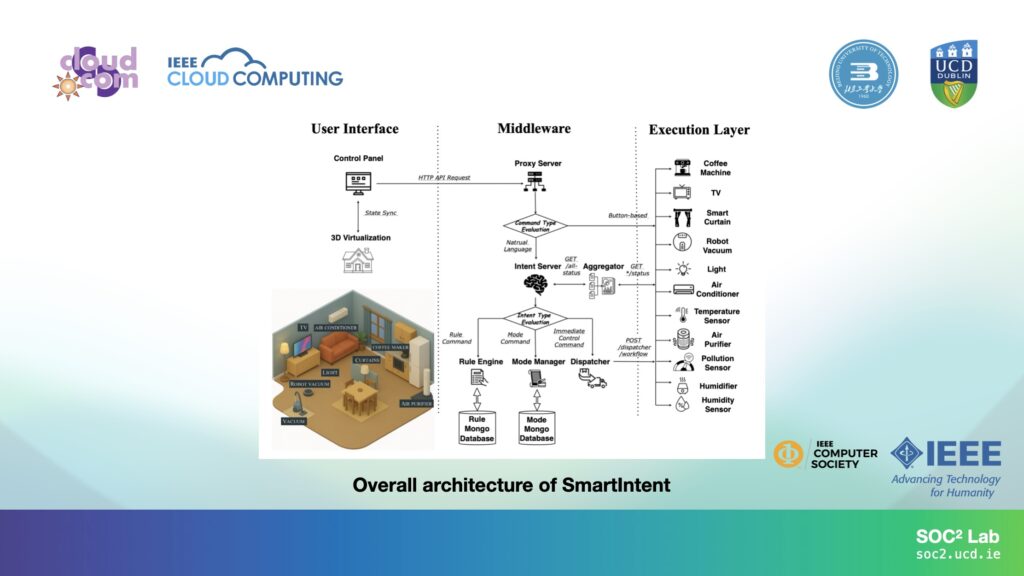
Current smart building systems often face challenges such as complex device linkage and limited natural language understanding. Our research lab addresses these with SmartIntent, an innovative, intent-recognition-based smart building control system. It aims to build a system that allows users to perform multi-language, multi-device, and multi-mode control and automation settings through natural language.
The Power of Serverless and LLMs
SmartIntent’s robust foundation lies in its microservice architecture and Knative Serverless deployment, combined with Large Language Models (LLMs) to achieve semantic parsing, context understanding, and device control command generation.
Serverless Scalability
The system adopts a microservice architecture and Knative Serverless deployment, which greatly improves scalability and elasticity. This ensures zero operation and maintenance delivery, high availability, and on-demand resource scheduling capabilities.
LLM-Powered Intent Understanding
The LLM Intent Parsing Module is central to SmartIntent’s intelligence. It converts natural language commands into structured JSON instructions or automation rules. We’ve utilized advanced LLMs like Grok 3 Beta for their strong performance in knowledge-intensive reasoning, long-context comprehension, and broad multi-task generalization, crucial for interpreting diverse user instructions.
Our research found that providing a small number of input/output examples (Few-shots) significantly improved model accuracy, while adding more (Many-shots) led to diminishing returns and increased token overhead. Fine-tuning with a high-quality, compact dataset of around 200 Chinese instructions achieved near-maximal accuracy and showed strong cross-lingual generalization, significantly reducing data annotation and training costs for multilingual tasks.
SmartIntent in Action: Orchestrating Your Space
The middleware layer, described as the system’s “core processing unit,” coordinates user intent with device operations. It comprises:
- Proxy Server: Central routing gateway.
- Intent Server: Parses natural language commands.
- Aggregator: Collects real-time device and sensor data.
- Dispatcher: Distributes structured control commands.
- Rule Engine: Manages automation rules.
- Mode Manager: Supports predefined multi-device workflows.
The Future is Smart and Intuitive
SmartIntent offers a “feasible design idea and realization paradigm for the next-generation smart building system”. Future work will focus on integrating more real user behavior data, improving model robustness under non-standardized representations, and optimizing performance for larger-scale device environments.
Resources
We have made the following resources available for the SmartIntent project:
Project Members
Beijing Dublin International College, UCD
Shuyi Sun
Zhiyuan Chen
Dina Shi
Chaofan Li
School of Computer Science, UCD
Zhenghao Wu
Hadi Tabatabaee Malazi